Modeling electrode materials for fuel cells
Theoretical design and characterization of catalytic materials that improve the activity, stability and cost of the electrodes used in clean energy technologies.
- DFT
- DFT+U
- VASP
- WIEN2K
- DACAPO
CONICET · UNS · IFISUR
I study catalytic materials for clean energy and environmental remediation. For more than thirty years I have worked between first principles simulation and experimental surface physics.
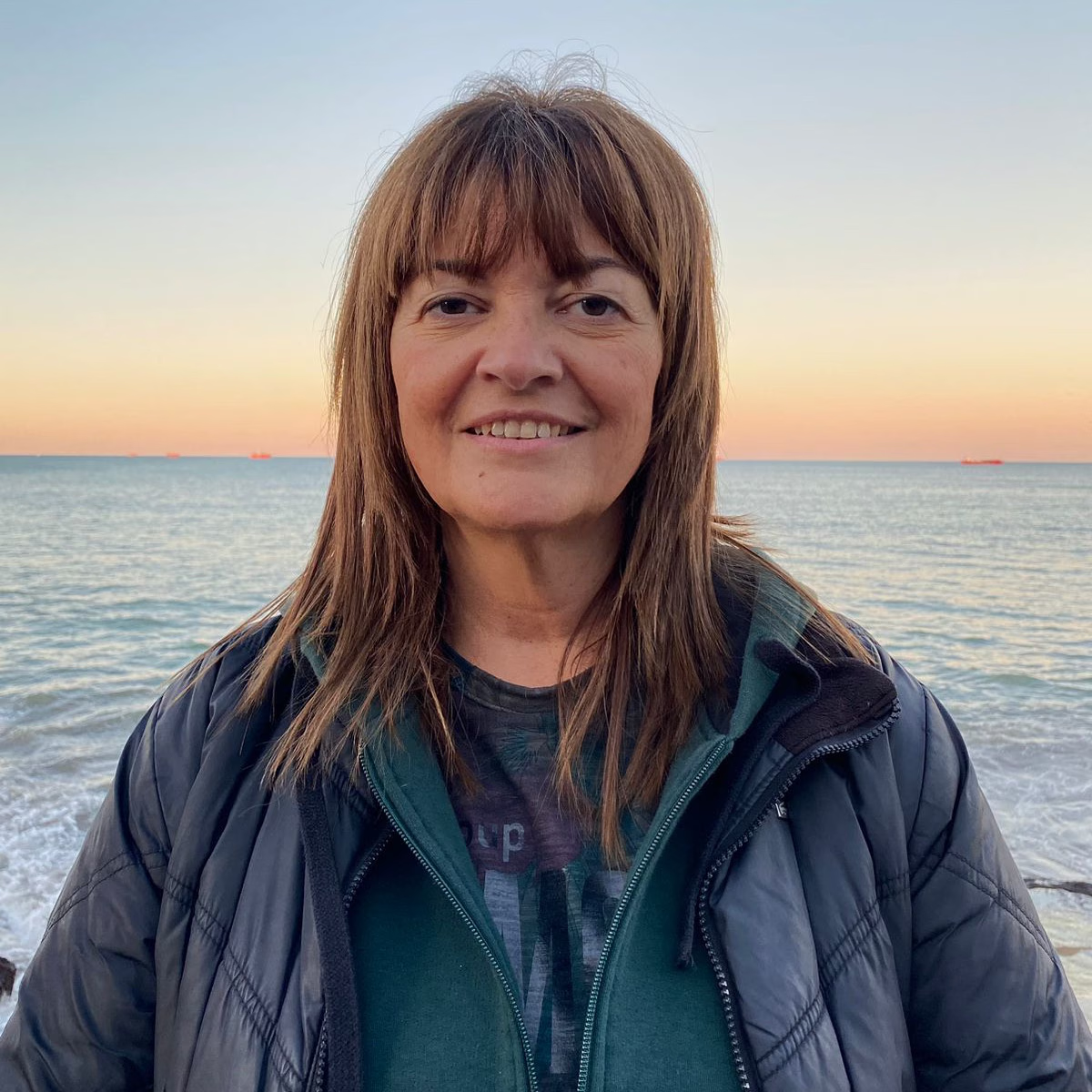
Profile
The question running through my work is simple to state and hard to answer: what makes a material a good catalyst. The answer rarely lies in its overall composition. It lies in the electronic structure of the surface, in the vacancies that disorder it, and in how all of that changes when a foreign atom is added.
I approach it from two fronts that usually stay apart. On one side, first principles calculations that can explore a far wider range of compositions than the laboratory allows. On the other, experimental surface physics techniques that put the model’s predictions to the test.
The result is materials designed for concrete problems: more efficient electrodes for fuel cells, photocatalysts able to break down pollutants and kill bacteria, oxides that work as gas sensors. Basic science with an explicitly applied purpose.
Research lines
Both are registered in my official CONICET profile and underpin my scientific output of recent years.
Theoretical design and characterization of catalytic materials that improve the activity, stability and cost of the electrodes used in clean energy technologies.
How surfaces, defects and composition at the nanoscale change catalytic behavior in reactions of environmental and energy interest.
Output
Indicators from public profiles change over time. Each one is shown here with its source and the date it was retrieved.
Publications
A recent selection. The full catalog includes indexed articles, a book chapter and conference papers.
S. Fuente, Cecilia I. N. Morgade, Gabriela F. Cabeza
Computational Materials Science 268, pp. 114646
Gabriela F. Cabeza, S. Fuente, Cecilia I. N. Morgade
Surfaces and Interfaces 88, pp. 109098
Sergio Schinca Vanini, Gabriela F. Cabeza
Next Materials 10, pp. 101498
Marisa Julia Sandoval, Lorena Inés Brugnoni, Flavia M. Carranza, S. L. Claus, A. S. Lorenzetti, C. E. Domini, C. A. Neyertz, Gabriela F. Cabeza, Cecilia I. N. Morgade
Emergent Materials 8 (3), pp. 1647-1658
Cecilia I. N. Morgade, Ana Belén Schvval, Silvia A. Fuente, J. C. Durán Álvarez, C. Buono, P. M. Desimone, C. M. Aldao, Gabriela F. Cabeza
Topics in Catalysis
María Julia Jiménez, R. R. Gimaev, V. I. Zverev, Gabriela F. Cabeza
Journal of Magnetism and Magnetic Materials 538, pp. 168258
Career
Licentiate in Physics, Universidad Nacional del Sur.
Research stays in Valencia, Strasbourg and Barcelona.
PhD in Materials Science and Technology, Universidad Nacional del Sur.
I chaired the Coordinating Council of the Graduate Program in Materials, PROMAT.
Independent Researcher at CONICET.
Director of three research group projects at the UNS.
Full Professor, full time, and Academic Secretary of the Department of Physics.
Impact and service
Beyond my own publications, much of my work consists of evaluating the work of others and sustaining the system that makes it possible.
Full member of doctoral and undergraduate thesis committees at 6 universities in Argentina and Uruguay, from 2013 to 2026.
Reviewer for admission to the CONICET Researcher Career and for PICT and PIP projects, and international peer reviewer of the Licentiate in Physics at the PUC de Chile.
Surface Science, Applied Surface Science, Surfaces and Interfaces, Computational Materials Science and 22 more journals.
See all journalsIn addition to 165 presentations at national and international scientific meetings.
Science communication
I produced and hosted this weekly show on Radio Universidad, AM 1240, from 2012 to 2015. It received 2 awards. Today I continue to share science through Ciencia en juego, part of CONICET’s VOC.AR program.
I am open to academic collaborations, to projects that combine experimental and computational work, and to inquiries from students interested in joining the group.